

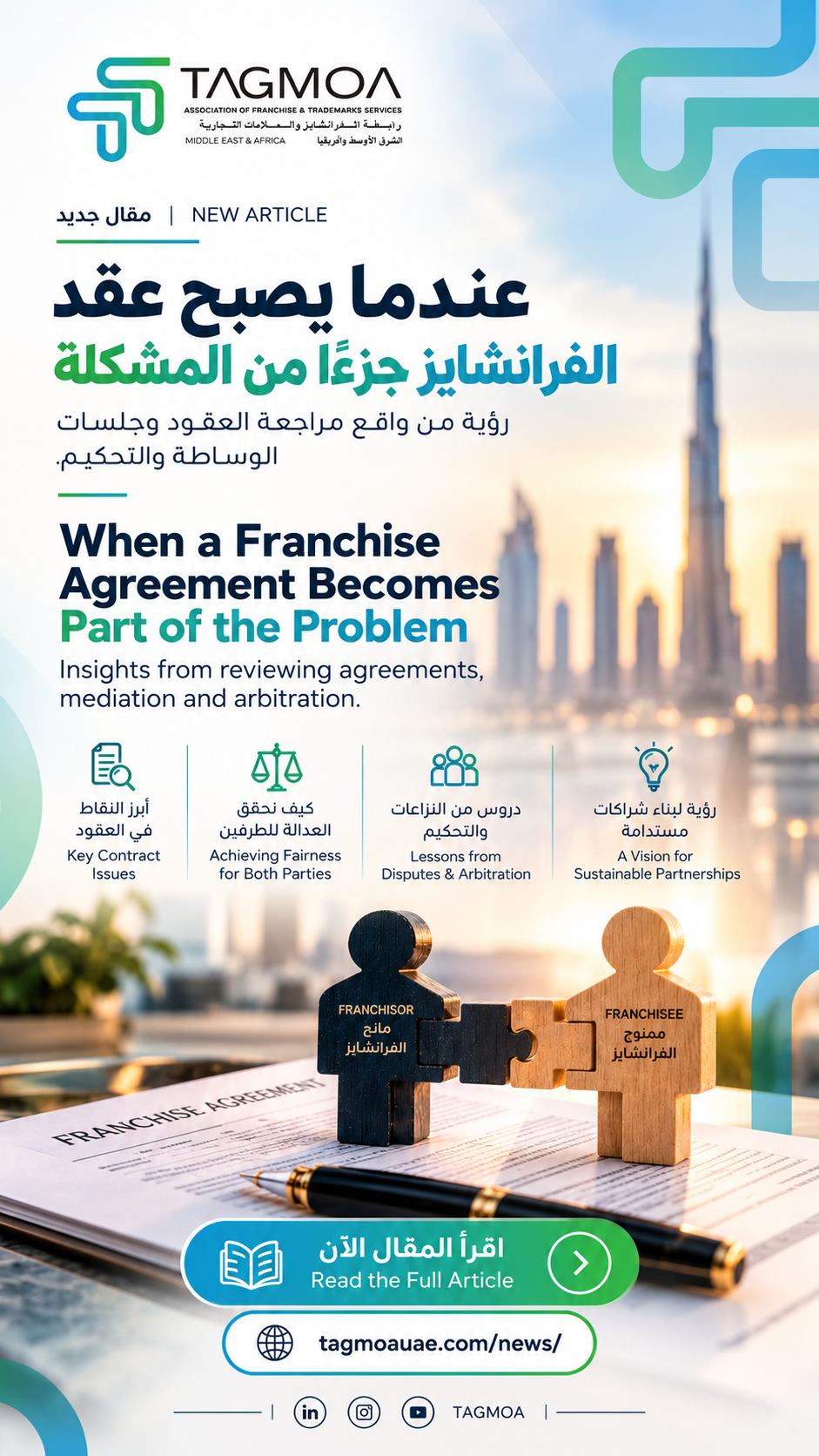
When a Franchise Agreement Becomes Part of the Problem Instead of the Foundation for Success
When a Franchise Agreement Becomes Part of the Problem Instead of the Foundation for Success
Most franchise relationships begin with a shared ambition.
A franchisor has built a successful brand and is looking to expand. A franchisee sees an attractive investment opportunity in that brand. Both parties come to the table discussing the market, location, sales potential, growth, and future outlets.
Then comes the Franchise Agreement — the document that transforms those ambitions into a long-term commercial and legal relationship.
This is precisely where the quality and balance of the agreement become critical.
A franchise agreement should not simply serve as a mechanism to protect the franchisor, nor should it attempt to shield the franchisee from the normal risks of investment. It should provide a clear framework defining who has decision-making authority, who carries responsibility, who bears the costs and risks, and what rights each party receives in return.
What Have We Learned from Franchise Agreements and Disputes?
Through our work at TAGMOA – The Franchise & Trademark Association for the Middle East & Africa, we have reviewed a significant number of franchise agreements and gained valuable insights through mediation and arbitration proceedings.
One recurring observation is that the problem often does not lie in a single clause.
Instead, it emerges from the cumulative effect of multiple provisions, powers, restrictions, and obligations.
Each clause may appear commercially reasonable when considered in isolation. But when the agreement is examined as a whole and we ask, Who has the authority? Who bears the cost? Who carries the risk?, a very different picture may emerge.
Some areas that deserve particular attention include:
- Changes to the operating system: The franchisor may retain broad authority to modify its systems and operating standards, while the franchisee may be required to bear some of the costs associated with implementing those changes.
- Marketing contributions: The franchisee may be required to make mandatory marketing contributions, while the franchisor retains broad discretion over the management of the marketing fund, campaigns, and allocation of expenditure.
- Non-compete restrictions: The agreement may impose significant restrictions on the franchisee’s commercial activities during the term, with certain restrictions continuing after the relationship ends.
- Termination provisions: Some agreements contain numerous grounds for termination, including circumstances where termination may occur without an opportunity to remedy the breach, while other breaches provide only a limited cure period.
- Post-termination obligations: The franchisee may be required to discontinue use of the brand, return confidential information and materials, settle outstanding amounts, remove brand-related elements from the premises, and bear certain associated costs.
- Transfer or sale of the business: The franchisee’s ability to sell or transfer the business may be subject to extensive approvals, conditions, procedures, and financial obligations.
The issue is not necessarily the existence of these provisions. Many serve legitimate commercial and legal purposes in protecting the brand and the integrity of the franchise system.
The concern arises when the cumulative allocation of authority, costs, obligations, and risks creates a relationship that is commercially unbalanced in practice.
Protecting the Brand Is a Right — Protecting the Investment Is Essential
A franchisor may have spent years building its brand, developing its operating system, accumulating know-how, and establishing market reputation.
It has every right to protect those assets.
But on the other side of the relationship is an investor who may commit substantial capital, lease premises, recruit employees, purchase equipment, carry operating expenses, and remain responsible for royalties, fees, and compliance with the brand’s standards.
If we recognize the brand as an asset worthy of protection, we should also structure the relationship in a way that recognizes and protects the investment operating under that brand.
Fairness Does Not Mean Equality
This is one of the most important distinctions we have learned.
A fair franchise agreement does not mean giving the franchisor and franchisee identical rights.
Their roles are fundamentally different.
The franchisor must retain sufficient authority to protect the brand, intellectual property, operating system, customer experience, and quality standards.
The franchisee, however, requires sufficient clarity regarding the investment, costs, contractual rights, territory, support, corrective procedures, renewal, transfer, and exit mechanisms.
Fairness therefore means creating an appropriate relationship between:
Authority and responsibility.
Responsibility and risk.
Risk and return.
Four Questions That Can Change How You Read a Franchise Agreement
When reviewing a franchise agreement, it is not enough to ask:
“Does this clause protect the franchisor?”
Four additional questions should be considered:
- Who has the authority to make the decision?
- Who bears the cost of that decision?
- Who carries the risk if the decision does not succeed?
- What corresponding protection or right does the other party receive?
These four questions can reveal more about the true commercial balance of a franchise relationship than dozens of pages of legal terminology.
The Strongest Agreement Is Not Necessarily the Most Restrictive
There is an important distinction between a strong franchise agreement and an overly restrictive one.
An overly restrictive agreement may seek to give one party the broadest possible authority while placing the greatest possible obligations on the other.
A strong agreement does something different.
It protects the brand without undermining the commercial viability of the franchisee’s investment, while protecting the franchisee without compromising the franchisor’s ability to maintain its standards and system.
More importantly, a well-designed agreement should address what happens when the business succeeds — not only what happens when things go wrong.
What happens when the outlet performs exceptionally well?
How does the franchisee qualify for additional locations?
How are reinvestment and expansion handled?
What happens if the franchisee wishes to sell the business?
How does the relationship evolve as the brand itself evolves?
A professional franchise agreement should not merely regulate failure. It should also provide a framework for success.
From an Agreement That Controls the Relationship to One That Strengthens It
At TAGMOA – The Franchise & Trademark Association for the Middle East & Africa, we believe that building a sustainable franchise sector requires changing the question we ask when drafting franchise agreements.
Instead of asking:
“How do we make the agreement stronger for one party?”
We should ask:
“How do we make the franchise relationship stronger for both parties?”
An agreement that protects the brand, intellectual property, operating standards, and integrity of the franchise system.
At the same time, an agreement that provides clarity around the investment, rights, obligations, costs, corrective mechanisms, exit arrangements, and dispute-resolution process.
Ultimately, franchise success should not be measured solely by the number of agreements signed or outlets opened.
It should also be measured by the ability of the franchisor and franchisee to grow together within a relationship that is clear, balanced, commercially viable, and sustainable.
The best franchise agreement is not the one that determines who will prevail when a dispute arises. It is the one designed from the outset to reduce the reasons for that dispute to arise in the first place.
TAGMOA – The Association of Franchise & Trademark Services (TAGMOA) – Middle East & Africa